
Last Saturday ago, I found myself in a very unusual “podcast” — sitting “across” from Mr. Randell Tiongson, one of the most respected personal finance voices in the country, talking to a room full of DepEd teachers about protecting their income.
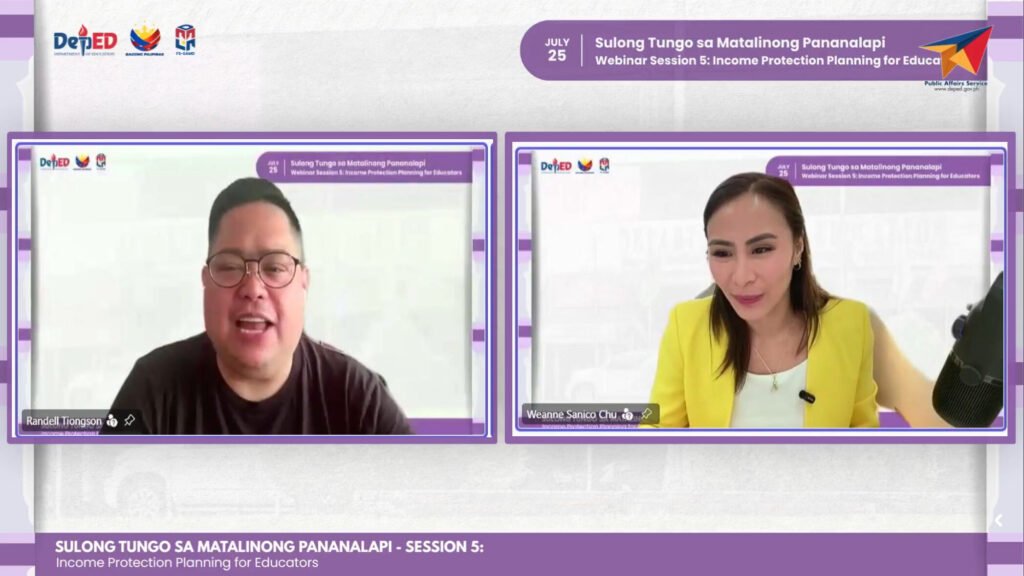
At one point, almost offhand, he said something that I haven’t stopped thinking about since:
“Personal finance is about 80% behavior, and only 20% knowledge.”
I’ve been in this industry for almost 14 years. I’ve sat through hundreds of conversations about insurance, investments, and income protection. And if I’m honest, that one line captured something I’ve quietly believed for a long time but never said out loud quite so simply.
We Don’t Have a Knowledge Problem Anymore
Here’s the uncomfortable truth: it’s 2026. Information is everywhere.
There are free webinars like the one we just ran. There are finance podcasts, YouTube explainers, budgeting apps, and enough “5 money habits to build wealth” carousels to last a lifetime of scrolling. Whatever you want to know about saving, investing, or insurance — it’s out there, usually for free, usually in under ten minutes.
So if the information is this available, why are so many of us still stuck?
Because knowing what to do and actually doing it are two completely different skills. And nobody teaches the second one.
The Gap Isn’t in Your Head — It’s in Your Habits
I think about this a lot through the lens of how I was trained to manage projects. A project rarely fails because the team didn’t understand the plan. It fails because of execution — because the plan met real life, real constraints, real people, and nobody built in the discipline to follow through when things got hard.
Money works exactly the same way.
You already know you should have an emergency fund. You already know debt with high interest is dangerous. You already know “buy now, pay later” isn’t actually free. None of that is new information.
What’s missing isn’t a fact. It’s a habit — the muscle of consistently choosing the harder, less exciting option today so that future-you isn’t the one paying for it.
Sir Randell had a line for this too: “Choose your hard.” Either you sacrifice a little today and enjoy more tomorrow, or you enjoy today and sacrifice tomorrow. Either way, something gets sacrificed. The only real choice is when.
Why This Matters More for Some of Us
During the webinar, we talked about a pattern that’s especially true for a lot of Filipino families: many of us aren’t just budgeting for ourselves. We’re the “sandwich generation” — supporting parents, helping siblings, saving for our own kids, sometimes all at once, all from one paycheck.
When that’s your reality, “just save more” isn’t useless advice — it’s just incomplete advice. What actually helps is smaller, more honest: pick one habit, automate it, and let it run quietly in the background instead of relying on willpower every single payday.
That’s really the whole idea behind forced savings. If you can automate a loan payment, you can automate a savings transfer. It’s the same discipline, just redirected toward yourself instead of a lender.
So What Do You Actually Do With This?
I’m not going to pretend behavior change is simple — if it were, none of us would still be having this conversation. But here’s where I’d start, and it’s the same thing I’d tell a friend, not just a client:
- Pick one habit, not five. Trying to fix your entire financial life in a weekend usually means fixing none of it.
- Make it automatic wherever you can. Systems beat motivation, especially on the days motivation doesn’t show up.
- Give it a review date. Not “someday” — an actual date on your calendar, even if it’s just once a year.
That’s it. That’s the whole first step. Not a spreadsheet, not a five-year plan — just one decision, repeated on purpose, instead of by default.
If any part of this landed for you, I’d love to know which one. And if you’re someone who’s been meaning to start “someday” — consider this your nudge that someday can just be this week.